AAC Blocks in Pakistan complete Guide 2026: Cost & Construction Guide 2026: You’re sitting in your drawing room in June. The AC has been running since 9 AM. It’s now 3 PM. The electricity meter is spinning. The room still doesn’t feel as cool as it should. And somewhere upstairs, your top-floor bedroom is essentially a tandoor.
This is the reality of life in a Pakistani home built the traditional way — four walls of solid red brick and a concrete slab, designed in an era when energy was cheap, climate change wasn’t a daily lived experience, and nobody was thinking about the thermal performance of their building envelope.
Now fast forward to a different scenario. A neighbor’s new house in the same street, same size, same city. Their AC runs two to three hours later than yours every morning before it’s needed. Their electricity bill is meaningfully lower than yours. Their walls feel cool to touch even in the afternoon. And their house was built — from grey structure to completion — in significantly less time than yours was.
The difference? AAC blocks.
Autoclaved Aerated Concrete blocks are one of the most significant building material developments to reach Pakistani construction in the past decade — and at Dilaawar Interiors, our architectural and construction teams have been specifying them across residential and commercial projects in Lahore for several years now. We’ve seen firsthand what they deliver in Pakistan’s specific climate, construction environment, and cost reality.
In this complete 2026 guide, we’re sharing everything Pakistani homeowners, property developers, and builders need to know about AAC blocks — what they are, how they’re made, how they compare to traditional red bricks, their real advantages and honest limitations, PKR cost estimates, and exactly where and how to use them for maximum benefit in Pakistani construction.
What Are AAC Blocks? — Understanding the Material
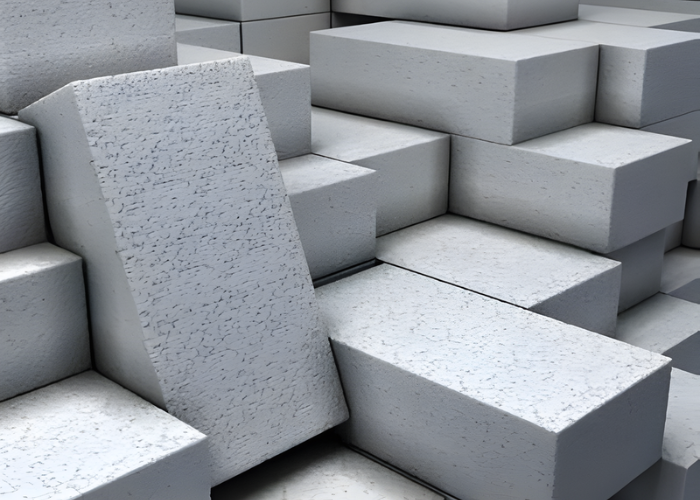
Before getting into comparisons and costs, let’s establish exactly what AAC blocks are — because there is still significant confusion in Pakistan’s construction market about this material and how it differs from other concrete block products.
The Science Behind AAC — How It’s Made
AAC stands for Autoclaved Aerated Concrete — and each word in that name tells you something important about what the material is and how it performs.
Aerated means the concrete contains millions of tiny air pockets distributed throughout its structure — created during manufacturing when aluminium powder is added to the raw mix and reacts chemically with the cement and lime to produce hydrogen gas. These hydrogen gas bubbles expand the mixture significantly — roughly doubling its volume — before the mix sets. The result is a cellular, porous structure that looks almost foam-like in cross-section.
Autoclaved refers to the curing process. After the aerated mixture is poured into moulds and allowed to set to a semi-solid state, it is cut into blocks and placed in an autoclave — a large high-pressure steam chamber — where it is cured at 180°C under high pressure for 8 to 12 hours. This autoclaving process completes the chemical reactions in the material, creating a stable crystalline structure that gives the block its final strength, dimensional stability, and durability.
The raw materials — cement, lime, fine sand or fly ash, water, and aluminium powder — are all non-toxic, widely available, and relatively low-impact compared to the fuel-intensive firing process required to manufacture traditional red clay bricks.
What AAC Blocks Look Like and Feel Like
If you’ve never handled an AAC block, the first experience is always surprising. A standard AAC block measuring 600mm x 200mm x 200mm — which is significantly larger than a standard Pakistani brick — feels remarkably light. You can lift it easily with one hand. Cut into it with a standard hand saw and it cuts cleanly and easily, like dense polystyrene foam. Hold it up and you can see the porous, cellular interior structure clearly.
Yet this apparently lightweight, easy-to-cut material, when assembled and finished as a wall, provides structural performance, fire resistance, and thermal insulation that traditional brick walls simply cannot match at the same wall thickness.
That combination — light, workable, and high-performing — is exactly what makes AAC blocks such a compelling proposition for Pakistani construction.
💬 Building a new home or commercial project in Lahore and considering AAC blocks? at Dilaawar Interiors architectural team will assess your project and advise whether AAC blocks are the right choice for your specific construction goals and budget. 📲 WhatsApp Us for a Free Construction Consultation | 📞 Call Us Today
AAC Blocks vs Traditional Red Clay Bricks — The Pakistan Comparison
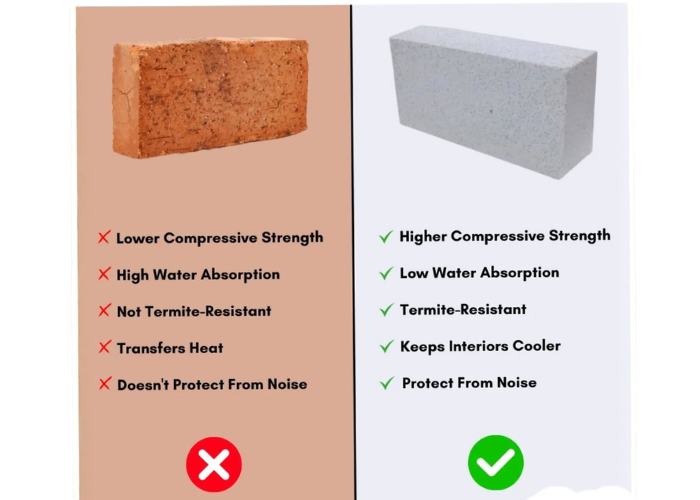
To understand why AAC blocks matter for Pakistani construction, you need to understand what traditional red clay bricks — Pakistan’s dominant masonry material for centuries — actually deliver and where they fall short in today’s construction environment.
Side-by-Side Comparison Table
| Property | AAC Blocks | Red Clay Bricks | Winner |
| Weight (per unit) | 3 – 4 kg (standard block) | 3 – 3.5 kg (per brick, but 8-10 needed per AAC equivalent) | ✅ AAC |
| Thermal Insulation | Excellent (R-value 0.8–1.25 per inch) | Poor (R-value 0.2 per inch) | ✅ AAC |
| Sound Insulation | Very Good (STC 40–45) | Moderate (STC 35–40) | ✅ AAC |
| Fire Resistance | Up to 1,200°C | Up to 600°C | ✅ AAC |
| Construction Speed | Fast (larger unit, fewer joints) | Slower (smaller unit, more joints) | ✅ AAC |
| Dead Load on Structure | Low (650 kg/m³ density) | High (1,700 kg/m³ density) | ✅ AAC |
| Material Cost Per Sq Ft Wall | PKR 55 – 90 per sq ft | PKR 40 – 70 per sq ft | ⚠️ Bricks (initial) |
| Total Project Cost | Lower (less steel, cement, labor) | Higher (more structural support needed) | ✅ AAC |
| Environmental Impact | Low (no kiln firing needed) | High (kiln-fired, destroys topsoil) | ✅ AAC |
| Dimensional Accuracy | Excellent (factory precision) | Variable (handmade variation) | ✅ AAC |
| Plastering Required | Minimal (smooth surface) | Standard (rough surface) | ✅ AAC |
| Termite and Mold Resistance | Excellent (inorganic) | Moderate (absorbs moisture) | ✅ AAC |
| Availability in Pakistan | Growing (major cities) | Widely available | ✅ Bricks |
| Skilled Labor Requirement | Some training needed | Widely available skills | ✅ Bricks |
The True Cost Comparison — Why AAC Blocks Are Often Cheaper Overall
This is the most important and most misunderstood aspect of AAC blocks in Pakistan. When people hear that AAC blocks cost more per unit than red bricks, they conclude that AAC construction is more expensive. This conclusion is wrong — and understanding why requires looking at the complete construction cost picture rather than just the material unit cost.
Where AAC blocks save money in a Pakistani construction project:
Because AAC blocks are significantly lighter than brick and concrete, the total dead load on a building’s structure is dramatically reduced. This means the structural design can use less steel reinforcement in columns and beams, thinner concrete sections in slabs, and a less heavy foundation — all of which are significant cost items in Pakistani construction. For a typical 5 marla house, the structural savings from switching to AAC blocks can amount to PKR 1,50,000 to PKR 4,00,000 depending on the original structural design.
AAC blocks require significantly less mortar at joints because they are manufactured to precise, consistent dimensions — the joints between AAC blocks are typically 3 to 5mm thick compared to 10 to 15mm for brick joints. Over an entire building, this reduces mortar material cost and the labor time for laying joints.
The smooth, precise surface of AAC block walls requires significantly less plaster than rough brick walls — in many cases, a skim coat or thin-coat plaster system can be used instead of the full 15 to 20mm plaster coat that brick walls require. This saves both material and labor cost.
AAC blocks are significantly faster to lay than bricks — each AAC block replaces approximately 8 to 10 standard Pakistani bricks in wall area covered. For skilled masons, productivity per day in AAC construction is typically 3 to 4 times higher than in brick construction for equivalent wall area. This directly reduces labor cost and project duration.
And over the building’s lifetime — the most significant saving of all — AAC blocks’ superior thermal insulation reduces cooling and heating energy consumption meaningfully, directly reducing monthly electricity bills for the life of the building.
When all of these savings are totalled across a complete construction project, AAC block construction typically costs 5 to 15 percent less than equivalent brick construction for the complete project — despite the higher per-unit material cost of the blocks themselves.
The 10 Key Advantages of AAC Blocks for Pakistani Construction
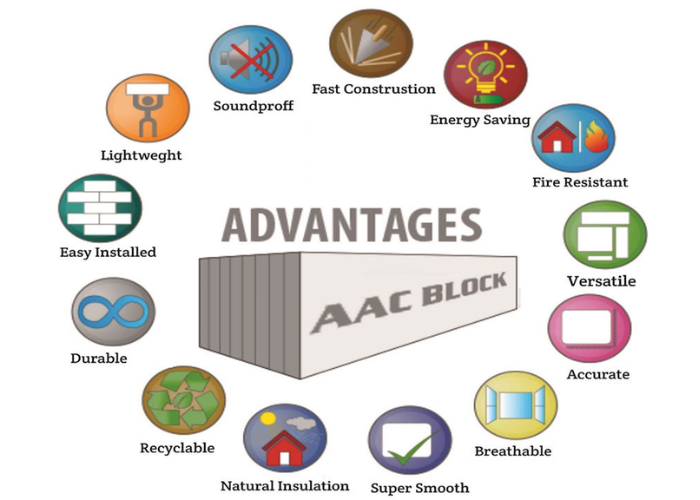
Advantage 1: Superior Thermal Insulation — Critical for Pakistan’s Climate
This is the advantage that matters most for Pakistan — and the one that has the most direct, measurable impact on the daily lives of people living or working in AAC-constructed buildings.
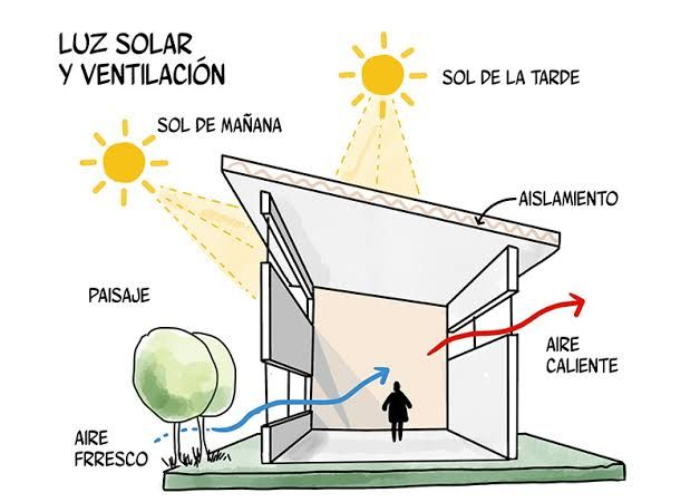
Pakistan’s climate is one of the most thermally demanding in the world for building materials. Summer temperatures in Lahore, Multan, and Faisalabad regularly exceed 45°C. Winters in northern Punjab can drop to near freezing. Buildings need to resist heat transfer in both directions — keeping interiors cool in summer and warm in winter — to deliver comfort without unsustainable energy consumption.
Traditional red brick has a thermal conductivity of approximately 0.6 to 0.8 W/mK — meaning it transfers heat relatively freely through its mass. AAC blocks have a thermal conductivity of approximately 0.12 to 0.18 W/mK — meaning they transfer heat at roughly 4 to 5 times less rapidly than brick. For a Pakistani homeowner, this means:
A top-floor room in an AAC-constructed home stays measurably cooler during peak summer afternoon hours than the same room in a brick-constructed home. The room does not cool down as fast at night because heat doesn’t transfer as easily, but the peak daytime temperature is significantly lower — which is what matters most for comfort and AC efficiency.
Your air conditioner reaches the set temperature faster, runs less frequently to maintain it, and consumes less electricity overall. Independent studies in similar climates suggest that AAC construction can reduce cooling energy consumption by 15 to 30 percent compared to equivalent brick construction.
For a typical Pakistani 5 marla home running 3 to 4 AC units for 6 to 8 months of the year, the annual electricity saving from AAC construction can range from PKR 40,000 to PKR 1,20,000 — year after year for the lifetime of the building.
Advantage 2: Significantly Lighter — Structural and Cost Benefits
AAC blocks have a density of approximately 500 to 700 kg/m³ — compared to red clay bricks at approximately 1,700 to 1,900 kg/m³ and dense concrete blocks at 2,000 to 2,200 kg/m³. This means an AAC wall of the same dimensions as a brick wall weighs approximately one-third as much.
For Pakistani construction, this weight reduction has cascading structural benefits. Lighter walls mean less load transmitted to beams, columns, and foundations. This directly reduces the structural steel and concrete requirements — and in Pakistan where steel prices are currently very high, this is a significant project cost saving. For multi-storey construction in particular, the weight reduction from AAC blocks in upper-floor walls can allow meaningful savings in the structural frame design throughout the building.
For renovation projects on existing buildings — adding upper floors, internal partitions, or room additions — AAC blocks are often the only feasible choice because the existing structure cannot accommodate the additional load that brick walls would impose.
Advantage 3: Dramatically Faster Construction Speed
Speed of construction translates directly into cost savings in Pakistani construction — reduced labor days, shorter project management periods, faster site establishment cost recovery, and earlier occupancy for the client. AAC blocks deliver speed advantages at multiple stages of construction.
Each standard AAC block (600x200x200mm) covers the same wall area as approximately 8 to 10 standard Pakistani bricks. A skilled mason working with AAC blocks can lay 3 to 4 times more wall area per day than the same mason working with standard bricks. This directly reduces the total mason labor days required for wall construction.
The precise dimensions of factory-made AAC blocks mean less time spent on alignment, leveling, and adjustment at every course of masonry. Thin-bed mortar — used instead of standard thick mortar joints — sets faster, allowing the next course to be laid more quickly.
AAC blocks can be cut to any required size using a standard hand saw or electric circular saw — no specialist cutting equipment, no noise of angle grinders cutting brick, no dust clouds of cutting concrete. This makes on-site adjustments for openings, services, and irregular dimensions fast and simple.
For a typical 5 marla Pakistani house, switching from brick to AAC block construction for external and internal walls typically reduces the wall construction phase by 3 to 5 weeks.
Advantage 4: Exceptional Fire Resistance
AAC is a completely non-combustible, inorganic material. It contains no flammable components. It will not burn, will not contribute fuel to a fire, and will not emit toxic gases when exposed to extreme heat — all of which are critical safety characteristics that traditional brick shares, but that timber, light steel framing, and many modern composite building materials do not.
AAC blocks can withstand sustained temperatures of up to 1,200°C — significantly above the 600°C rating of traditional clay brick. For multi-storey residential buildings, commercial construction, and any building where fire safety is a regulatory requirement, AAC’s fire resistance performance provides a meaningful safety margin.
In Pakistan, where many urban homes are built in dense residential areas with limited spacing between buildings, the fire resistance of the wall construction material has genuine life-safety implications. AAC walls resist fire spread between adjacent properties significantly better than lightweight partition systems.
Advantage 5: Excellent Sound Insulation for Urban Pakistani Living
Pakistan’s major cities — Lahore, Karachi, Islamabad — are genuinely noisy urban environments. Traffic, generators, mosques, markets, and neighboring construction all create acoustic environments that Pakistani homeowners increasingly want to separate their interior spaces from.
AAC blocks provide measurably better sound insulation than equivalent brick walls, primarily because the porous, cellular structure of the material absorbs and dissipates sound energy rather than simply transmitting or reflecting it. The air pockets within the material act as acoustic dampening chambers.
For urban Pakistani homes — particularly apartments in high-density areas, homes adjacent to main roads, and homes with shared walls with neighboring properties — AAC’s sound insulation advantage translates directly into improved quality of life for occupants.
For commercial buildings — offices, healthcare facilities, educational institutions — the sound insulation properties of AAC contribute to the productive, quiet interior environments these uses require.
Advantage 6: Eco-Friendly and Environmentally Responsible
Pakistan’s traditional red clay brick industry has a significant environmental cost that is only beginning to be properly acknowledged — brick kilns across Punjab and Sindh consume enormous quantities of fossil fuel for firing, contribute significantly to air pollution in agricultural areas, and permanently destroy the topsoil of agricultural land from which the clay is extracted.
AAC block manufacturing does not require high-temperature kiln firing. The autoclaving process is significantly more energy-efficient than brick kiln firing. The raw materials — cement, lime, fine sand, and fly ash (an industrial byproduct) — do not require the destruction of agricultural topsoil. The finished product is fully recyclable and does not generate toxic waste.
For Pakistani homeowners and developers who are increasingly aware of environmental impact — and for projects targeting green building certification — AAC blocks are the most environmentally responsible masonry material currently available in Pakistan.
Advantage 7: Pest, Termite, and Mold Resistance
Pakistan has serious termite and moisture-related problems in construction — particularly in areas with high water table, flood risk, or seasonal heavy rainfall. Traditional building materials that absorb moisture create environments where mold, mildew, and termite activity can establish within wall systems, causing structural damage and creating health hazards for occupants.
AAC’s completely inorganic composition makes it inherently resistant to termite attack — there is nothing in the material’s composition that termites can consume or inhabit. Its low moisture absorption rate — significantly lower than traditional brick — reduces the risk of moisture penetration and the mold and fungal growth that follows. In Pakistan’s monsoon-affected regions and in buildings near water bodies, this resistance has significant practical value for the long-term health and integrity of the building structure.
Advantage 8: Dimensional Precision and Reduced Finishing Cost
AAC blocks are manufactured in factory conditions with tight dimensional tolerances — typically ±1mm on all faces. This precision is simply impossible with traditional handmade Pakistani bricks, which can vary by 5 to 10mm between units and require thick mortar beds to accommodate the variation.
The smooth, precisely flat faces of AAC blocks produce walls that are already much closer to flat and plumb than brick walls before any finishing is applied. This means:
Less plastering material is required — a 6 to 8mm skim coat rather than the 15 to 20mm full plaster coat that brick walls typically need in Pakistan.
Less labor is required for plastering — the wall surface needs less preparation and correction before the finish coat.
Paint and other wall finishes go on more smoothly and require fewer coats to achieve a quality finish.
For a complete 5 marla house, the reduction in plastering material and labor from switching to AAC blocks can save PKR 50,000 to PKR 1,20,000.
Advantage 9: Easier to Work With — Services Integration
Running electrical conduit, plumbing pipes, and HVAC ducting through walls is a significant part of any construction project — and in brick construction, chasing channels for services requires loud, dusty, slow cutting with angle grinders that generates enormous quantities of debris and vibration that can crack the surrounding masonry.
AAC blocks can be chased for services with simple hand tools — a hand saw, a rasp, or a basic router — quickly, cleanly, and without vibration risk to the surrounding masonry. This makes the services installation stage faster, cleaner, and less disruptive to the surrounding construction.
Advantage 10: Long-Term Durability and Low Maintenance
AAC blocks, once properly installed and finished, require minimal maintenance over the building’s life. Their inorganic composition means they don’t rot, rust, or biologically degrade. Their low moisture absorption means they don’t experience the freeze-thaw cracking that affects masonry in Pakistan’s colder northern regions. Their dimensional stability means walls constructed with AAC blocks maintain their straightness and plumb over decades without the differential settlement cracking that is common in Pakistani brick construction.
For Pakistani homeowners who invest in their properties as long-term assets — and who have experienced the ongoing maintenance burden of traditional brick construction — AAC’s durability and low maintenance profile represents genuine long-term value.
💬 Ready to build smarter with AAC blocks? at Dilaawar Interiors construction team has hands-on experience with AAC block construction across residential and commercial projects in Lahore. We’ll advise you on the right specification for your project. 📞 Book Your Free Construction Consultation → dilaawarinteriors.com/contact
Honest Limitations of AAC Blocks in Pakistan — What You Need to Know
At Dilaawar Interiors, we believe in transparent, honest advice — and that includes being upfront about where AAC blocks have limitations that need to be managed carefully in Pakistani construction.
Limitation 1: Higher Initial Material Cost
The per-unit cost of AAC blocks is higher than the per-unit cost of standard red clay bricks in Pakistan. This is a real cost that needs to be acknowledged — even though the total project cost comparison often favors AAC when all savings are properly accounted for.
For clients with tight upfront construction budgets who cannot access the total-project-cost savings immediately, this initial material cost premium can be a genuine constraint. Our construction team always provides both a full cost comparison and a total-project-cost analysis so clients can make an informed decision.
Current AAC block price in Pakistan: PKR 45 – 80 per block depending on size, quality, and supplier For comparison: Standard red clay bricks cost PKR 12 – 20 per brick in Lahore 2026.
Limitation 2: Requires Trained Labor and Careful Handling
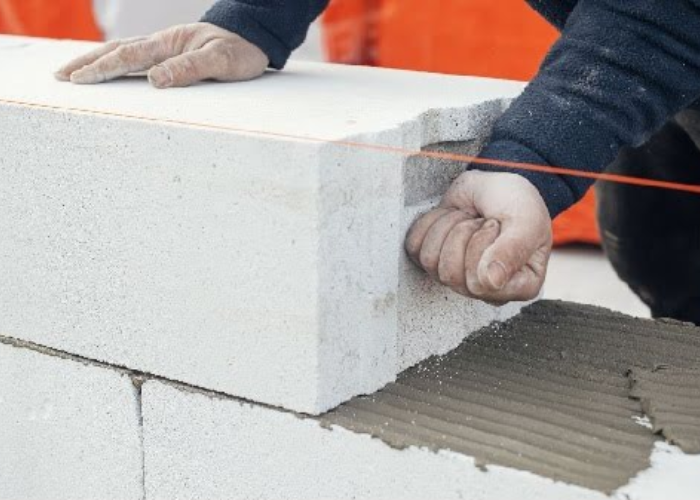
AAC blocks are a different material from brick — and while the techniques are learnable, masons who have only ever worked with brick will need training and a period of adjustment to work with AAC effectively. Key differences include:
The thin-bed mortar system used with AAC is different from standard brick mortar — it requires different mixing ratios, different application techniques, and different joint thicknesses. An experienced brick mason applying his standard technique to AAC will get poor results.
AAC blocks must be handled and stored carefully to avoid moisture absorption before installation — blocks that have absorbed significant moisture before being built into a wall can cause long-term problems with surface finish and dimensional stability.
At Dilaawar Interiors, our construction team has trained masons with hands-on AAC experience. We always ensure skilled supervision is in place for any AAC project. If you’re managing your own construction project without professional supervision, invest time in properly training your masons before beginning AAC work.
Limitation 3: Not Suitable for All Structural Applications
AAC blocks have compressive strength ranging from 2 to 4 N/mm² depending on density grade — which is adequate for most non-structural wall applications and is used in structural applications in many countries. However, in Pakistan’s seismic zones — particularly in KPK, Balochistan, and parts of northern Punjab — structural design requirements need to be carefully reviewed when specifying AAC blocks.
Always ensure that any building project using AAC blocks has been reviewed by a qualified structural engineer who is familiar with AAC construction and the specific seismic and loading requirements for the project location. This is standard practice in quality construction regardless of material — but it’s worth emphasizing specifically for AAC.
Limitation 4: Limited Availability Outside Major Cities
AAC blocks are manufactured by a limited number of suppliers in Pakistan — currently concentrated around Lahore, Karachi, and Islamabad. For construction projects in secondary cities, rural areas, and remote locations, availability may be limited and transportation costs from the nearest supplier can add meaningfully to the material cost.
Before specifying AAC blocks for a project, verify current supplier availability and transportation cost for your specific location. For projects in major cities, this is rarely a concern — for remote locations, it needs to be evaluated specifically.
Limitation 5: Requires Specific Fixings and Fasteners
Standard masonry nails and fixings that work reliably in brick walls do not work as well in AAC blocks due to the material’s cellular, porous structure. Hanging heavy items — kitchen cabinets, TV wall mounts, heavy artwork, bathroom accessories — on AAC walls require specific AAC-rated nylon plugs and screws rather than standard masonry fixings.
These appropriate fixings are readily available in Lahore and other major cities, but this requirement needs to be communicated clearly to homeowners who are accustomed to standard brick wall fixing practices.
AAC Block Types Available in Pakistan — Specifications and Uses
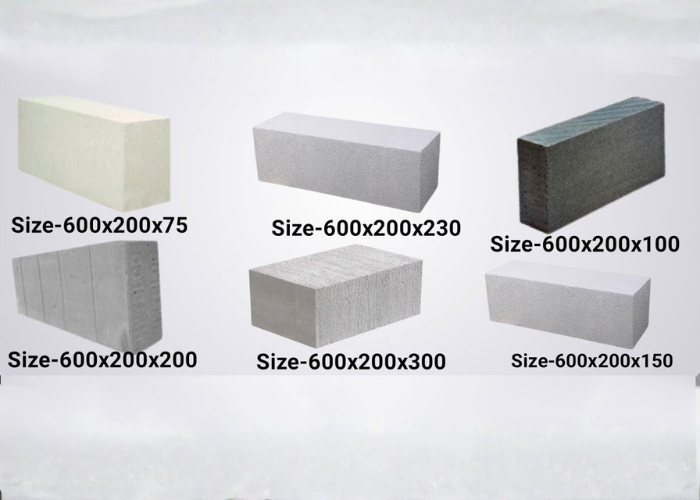
Standard Density AAC Blocks (600 kg/m³)
This is the most widely available AAC block specification in Pakistan and suitable for the majority of residential and commercial construction applications. Standard density blocks provide the best balance of thermal insulation, structural performance, and cost.
Typical dimensions available:
- 600 x 200 x 200mm (most common)
- 600 x 200 x 150mm (for thinner partitions)
- 600 x 200 x 100mm (for lightweight internal partitions)
Best applications: External walls, internal load-bearing partitions, staircase walls
Cost range: PKR 50 – 75 per block depending on size and supplier
High Density AAC Blocks (700-800 kg/m³)
Higher density blocks have greater compressive strength, but slightly reduced thermal insulation compared to standard density. Used where additional structural performance is required.
Best applications: Lower floor walls in multi-storey construction, walls carrying significantly imposed loads
Cost range: PKR 60 – 90 per block
AAC Block Panels and Slabs
In addition to standard blocks, AAC is available in larger panel and slab formats used for floor and roof construction— though these applications are less common in Pakistan’s current construction practice and require specific structural design.
Where to Use AAC Blocks in Pakistani construction — Application Guide
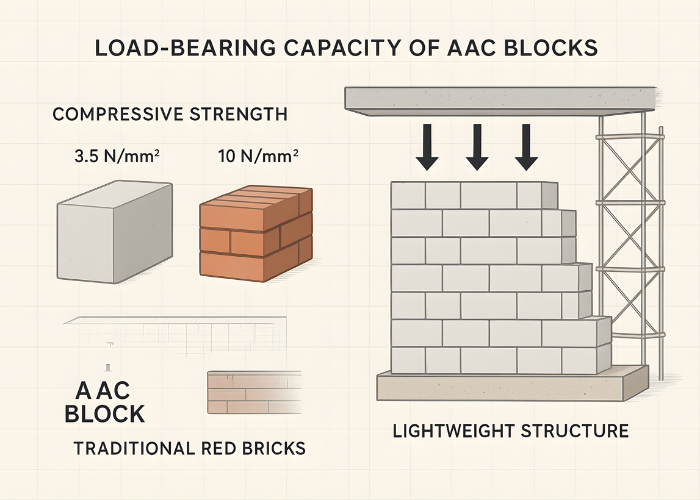
External Walls — The Highest Value Application
External walls are where AAC blocks deliver their most significant benefit in Pakistan — because it is the external walls that are the primary pathway for solar heat entering the building in summer. An AAC external wall of 200mm thickness provides dramatically better resistance to this solar heat gain than a standard 230mm brick wall — keeping interiors cooler, reducing AC load, and delivering ongoing electricity savings throughout the building’s life.
Recommendation: Specify AAC blocks for all external walls in new residential construction in Pakistan — the thermal performance benefit alone justifies the decision.
Internal Partition Walls — Speed and Acoustic Benefits
Internal walls in Pakistani homes traditionally use the same brick construction as external walls — which is significantly heavier and slower than necessary for non-structural partitions. AAC blocks at 100mm or 150mm thickness provide excellent partitions that are lighter, faster to build, better for sound insulation between rooms, and require minimal plastering.
Recommendation: Specify 100 to 150mm AAC blocks for all internal non-structural partitions. Save time, save cost, and improve acoustic separation between rooms.
Multi-Storey Residential Buildings
For apartment buildings, multi-storey villas, and any structure above two floors, the weight reduction from AAC block walls in upper floors directly reduces the structural steel and concrete requirements in the frame below. Cumulative weight saving across multiple floors compounds at every level — making the structural cost savings increasingly significant the taller the building.
Commercial Buildings — Offices, Hospitals, Schools
Commercial buildings benefit from every AAC advantage — thermal insulation reduces HVAC energy cost that is a significant operational expense for commercial properties, sound insulation improves the working environment, fire resistance meets commercial building code requirements, and faster construction reduces the financing cost and lost revenue of extended project timelines.
Boundary Walls and Compound Walls
The lighter weight of AAC blocks makes them an excellent choice for boundary walls and compound walls — where the reduced load on foundations and the faster construction speed both deliver direct cost savings. The smooth surface finish of AAC blocks also produces more attractive boundary walls that require less finishing work.
AAC Block construction Cost Guide for Pakistan — 2026 PKR Estimates
Material Costs
| AAC Block Type | Size | Cost Per Block | Cost Per Sq Ft Wall |
| Standard AAC (200mm) | 600x200x200mm | PKR 50 – 75 | PKR 55 – 85 |
| Standard AAC (150mm) | 600x200x150mm | PKR 40 – 60 | PKR 45 – 70 |
| Standard AAC (100mm) | 600x200x100mm | PKR 30 – 48 | PKR 35 – 55 |
| High density AAC | 600x200x200mm | PKR 65 – 90 | PKR 70 – 100 |
For comparison: Red clay brick wall (230mm) costs PKR 40 – 65 per sq ft in materials only (bricks + mortar)
Labor Costs for AAC Block construction
| Work Type | Labor Cost Per Sq Ft |
| AAC block laying (external wall) | PKR 35 – 55 |
| AAC block laying (internal partition) | PKR 28 – 45 |
| Thin-bed mortar application | Included in laying rate |
| Surface skim coat plaster (AAC) | PKR 25 – 40 |
| Surface skim coat plaster (brick, for comparison) | PKR 40 – 65 |
AAC block laying requires masons trained in thin-bed mortar technique. Rates may be slightly higher for first-time AAC projects while masons develop speed.
Complete Project Cost Comparison — 5 Marla House
| Cost Item | Brick construction | AAC Block Construction | Saving with AAC |
| External wall material | PKR 2,80,000 | PKR 3,50,000 | -PKR 70,000 |
| Internal wall material | PKR 1,80,000 | PKR 1,60,000 | +PKR 20,000 |
| Structural steel saving | — | PKR 1,80,000 saving | +PKR 1,80,000 |
| Foundation saving | — | PKR 80,000 saving | +PKR 80,000 |
| Plastering material saving | — | PKR 65,000 saving | +PKR 65,000 |
| Labor time saving | — | PKR 90,000 saving | +PKR 90,000 |
| Total Project Saving | — | — | +PKR 3,65,000 |
These are approximate estimates for illustration. Actual savings vary by design, market conditions, and contractor rates. Always request a detailed project-specific cost comparison.
Ongoing Energy Saving — The Lifetime Return
Beyond the construction phase savings, the thermal insulation advantage of AAC blocks delivers ongoing electricity savings throughout the building’s life. For a typical Lahore family running 3 to 4 ACs for 7 months per year, the estimated annual electricity saving from AAC vs brick construction ranges from:
Conservative estimate: PKR 40,000 – 60,000 per year Optimistic estimate: PKR 80,000 – 1,20,000 per year
Over 20 years of ownership, this cumulative electricity saving ranges from PKR 8,00,000 to PKR 24,00,000 — making AAC blocks one of the highest-return construction investments available in Pakistan.
AAC Blocks in Pakistani Climate — Special Considerations
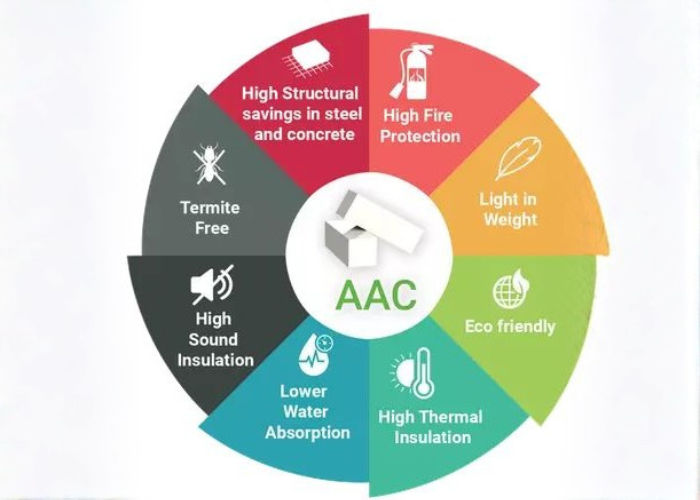
[H3] Performance in Lahore and Punjab’s Extreme Heat
Lahore’s summer climate — with temperatures exceeding 45°C from May through July and high solar radiation intensity — is one of the most demanding environments for building thermal performance in the world. AAC blocks’ superior thermal resistance is arguably more valuable in Lahore’s climate than in virtually any other construction context globally.
The cellular structure of AAC slows the passage of heat through the wall material so effectively that the peak interior temperature that would be reached in an external wall is both lower and occur several hours later in the day than in an equivalent brick wall — a phenomenon called thermal lag. In practice, this means AAC walls begin transferring significant heat into the interior space in the late afternoon or evening rather than at midday peak — by which time the exterior temperature has already begun declining.
Performance in Karachi’s Humidity
Karachi’s high humidity creates different demands on building materials — moisture absorption and mold resistance become critical. AAC blocks’ low moisture absorption rate (typically 15 to 20 percent by mass at saturation — compared to 30 to 40 percent for clay brick) makes them better suited to Karachi’s humid coastal environment. However, ensuring appropriate external waterproofing and render systems is essential for AAC construction in Karachi — the blocks perform well when properly detailed and poorly when moisture is allowed to saturate them.
Performance in Pakistan’s Seismic Zones
For construction in Pakistan’s higher seismic risk areas — Khyber Pakhtunkhwa, Baluchistan, and parts of Azad Kashmir — structural design must account for seismic loading in all wall and frame systems. AAC blocks can be used effectively in seismic zones when properly detailed with reinforced concrete frames — the blocks infill the structural frame rather than serving as the structure themselves. This is standard practice in seismically active countries where AAC is widely used. Always engage a qualified structural engineer for design in seismic zones regardless of masonry material.
How Dilaawar Interiors Specifies AAC Blocks in constructionProjects
At Dilaawar Interiors, we have developed a clear specification approach for AAC block construction based on our project experience in Lahore’s construction environment.
Our AAC Specification Approach
We specify AAC blocks for external walls on all new residential construction projects where the client’s brief includes energy efficiency and thermal comfort as priorities is increasingly the majority of our projects. We specify 200mm standard density blocks for external walls and 100 to 150mm blocks for internal partitions.
We specify thin-bed mortar from a reputable manufacturer — not site-mixed approximations of thin-bed mortar. The mortar specification is as critical as the block specification for AAC construction quality.
We specify a polymer-modified render or skim coat system for external and internal wall finishing rather than standard sand-cement plaster — this system is compatible with AAC’s movement characteristics and produces a finer, more durable finish.
We specify AAC-rated wall fixings and anchors for all services, kitchen, bathroom, and finishing trades — and we brief all trades on the appropriate fixing technique before they begin work on AAC walls.
And we ensure our site supervisor is specifically briefed on AAC construction supervision — checking block storage conditions, mortar mixing ratios, joint thickness, and wall straightness at every stage.
Projects Where We Recommend AAC Blocks
Strongly recommended: New residential construction in Lahore for energy-conscious homeowners. Multi-storey residential and commercial projects where structural weight saving is valuable. Any project where construction speed is a priority.
Recommended standard caveats: Construction in Karachi and humid coastal areas with appropriate external waterproofing specification. Projects in moderate seismic zones with standard reinforced frame design.
Not recommended without specialist structural input: Construction in high seismic risk zones without structural engineer review of the specific AAC application.
💬 Planning a new construction project and want honest advice on whether AAC blocks are right for your specific situation? Dilaawar Interiors provides free construction material consultation as part of our architectural services. No obligation, no pressure. 📲 WhatsApp Us for a Free Construction Advice Session
Where to Buy AAC Blocks in Pakistan — Supplier Guide 2026
AAC Block Suppliers in Lahore
AAC block supply in Lahore has grown significantly over the past five years. Multiple suppliers now operate in and around Lahore with manufacturing or distribution facilities. Key areas to source AAC blocks in Lahore include Sundar Industrial Estate, Kot Lakhpat industrial area, and several wholesale building material suppliers in Shahdara and Sagian Road. Always verify current availability, lead time, and delivery cost from your specific supplier before finalizing your specification.
Typical delivery time from order: 3 to 10 working days depending on block size and quantity
AAC Block Suppliers in Karachi
Karachi has established AAC block suppliers operating in the SITE and Korangi industrial areas. Import-based supply is also available for projects with sufficient scale to justify container quantities of premium international products.
AAC Block Suppliers in Islamabad and Rawalpindi
Supply in the twin cities has improved significantly. Several suppliers operate from the I-9 Industrial Area and surrounding areas. For large projects, direct procurement from Lahore-based manufacturers with delivery to Islamabad is also a viable and sometimes more cost-effective option.
What to Ask Any AAC Block Supplier Before Purchasing
Before committing to any AAC block supplier for a construction project, always ask for and verify:
The block’s compressive strength test certificate — ideally from an independent testing laboratory, not just a manufacturer’s claim. Minimum acceptable compressive strength for standard construction is 2.5 N/mm².
The block’s density specification — standard density (600 kg/m³) vs. high density (700-800 kg/m³) — to verify it matches your specification.
The manufacturer’s compliance with relevant standards — ideally ASTM C1386 or equivalent European or Pakistani standards.
A physical sample of the block before ordering in quantity — check for consistency of dimensions, absence of cracking, and uniformity of the cellular structure in cross-section.
Frequently Asked Questions — AAC Blocks in Pakistan
Are AAC blocks strong enough for Pakistani homes?
Yes — AAC blocks with a compressive strength of 2.5 to 4 N/mm² are structurally adequate for the wall applications in standard Pakistani residential construction when used within a properly designed reinforced concrete frame. They are used successfully in multi-storey residential and commercial construction globally. The key is ensuring your structural design is reviewed by a qualified engineer who accounts for AAC’s specific properties. For standard 5 to 10 marla residential construction in Lahore, AAC blocks are entirely appropriate.
How much does AAC block construction cost in Lahore compared to brick?
The upfront material cost of AAC blocks is approximately 20 to 35 percent higher than equivalent red clay brick for the same wall area. However, when structural savings (less steel and concrete), plastering savings, labor time savings, and reduced foundation requirements are all accounted for, AAC construction typically costs 5 to 15 percent less in total project cost than equivalent brick construction for a complete building. The additional factor is ongoing electricity savings from AAC’s superior thermal insulation — which over the building’s lifetime can amount to several million rupees in cumulative savings.
Can AAC blocks be used in Lahore’s extreme summer heat?
Yes — and AAC blocks are specifically recommended for Lahore’s extreme climate precisely because their thermal insulation properties are most valuable in high-heat environments. AAC walls slow the transfer of solar heat through the building envelope much more effectively than brick walls, keeping interior spaces cooler during peak summer hours and reducing cooling energy consumption meaningfully. This is one of the primary reasons Dilaawar Interiors recommends AAC blocks for new residential construction
Are AAC blocks available outside major cities in Pakistan?
Currently, reliable AAC block supply is primarily available in and around Lahore, Karachi, Islamabad, and a few other major cities. For construction projects in secondary cities or rural areas, supply may require transportation from a major city — which adds to material cost and lead time. Always verify current local availability for your specific project location before finalizing material specifications.
Do AAC blocks require special tools or skills to install?
AAC blocks require some adaptation of technique compared to standard brick laying — primarily in the use of thin-bed mortar (3 to 5mm joint thickness rather than the 10 to 15mm standard for brick), the use of a float or notched trowel for mortar application, and the use of hand saws or electric saws for cutting. Experienced brick masons can adapt to AAC construction with one to two days of hands-on instruction. The key is having a supervisor or site engineer who understands AAC construction technique and can guide the masons through the adaptation period.
Can heavy items be hung on AAC walls?
Yes — but they require specific AAC-rated wall fixings rather than the standard masonry nails and plugs used in brick walls. AAC-rated nylon plugs, chemical anchors, and specific AAC screws provide reliable fixing capacity in AAC walls for everything from picture frames to kitchen wall cabinets to TV wall mounts. These fixings are readily available from building material suppliers in Lahore and other major cities. Brief all contractors working on your AAC-construction project about the appropriate fixing system before they begin work.
Is AAC construction better for the environment than brick construction?
Yes — significantly. AAC block manufacturing requires approximately 30 to 40 percent less energy than equivalent red clay brick production, does not involve the destruction of agricultural topsoil (which brick clay extraction does), and produces a recyclable product with a smaller carbon footprint per unit of construction than traditional brick. For Pakistani homeowners and developers who are conscious of environmental impact — and for projects targeting green building certification — AAC blocks represent the most environmentally responsible masonry option currently available in Pakistan.
Does Dilaawar Interiors use AAC blocks in its construction projects?
Yes — Dilaawar Interiors specifies AAC blocks for external walls and internal partitions across many of our residential construction and renovation projects in Lahore, particularly for clients where energy efficiency, thermal comfort, construction speed, or structural weight reduction are project priorities. Our construction team has trained masons with hands-on AAC experience and our architectural team is familiar with the specific design details and material specifications required for quality AAC construction in Pakistan’s climate.
Ready to Build Smarter With AAC Blocks?
At Dilaawar Interiors , we believe the materials you build with are just as important as the design you build to — and in Pakistan’s climate, construction environment, and energy cost reality, AAC blocks represent one of the smartest building material choices available to Pakistani homeowners and developers today.
Whether you’re planning a new home from grey structure, adding floors to an existing property, designing a commercial space, or simply evaluating your options before committing to a construction specification — our architectural and construction team has the experience and honest expertise to advise you correctly.
What you get when you work with Dilaawar Interiors on your construction project:
- ✅ Free initial consultation and honest material specification advice
- ✅ Complete cost comparison — AAC vs brick for your specific project
- ✅ Structural engineer coordination for safe, code-compliant design
- ✅ Experienced site supervision with trained AAC construction masons
- ✅ Complete architectural drawing and construction management services
- ✅ Transparent PKR pricing with itemized quotations before commitment
📞 Call Us: +923111147157
💬 WhatsApp: +923111147157
🌐 Website: www.dilaawarinteriors.com
📍 Visit Us: Lahore, Pakistan.
📧 Email: [Your Email Address]
👉 Book Your Free Construction Consultation Today → dilaawarinteriors.com/contact
Written by the Design and Construction Team at Dilaawar Interiors— Lahore’s trusted name in affordable elegance. Have a question about AAC blocks or your construction project? Drop it in the comments below and our team will respond within 24 hours. 💬